Book Appointment Now

Best Vaginismus Treatment in Mumbai | Dr. Pavan Sonar – Sexologist
Vaginismus is one of the most common yet least talked-about female sexual health conditions in India. If penetration causes pain, fear, or is simply impossible — you are not alone, and you are not broken. Vaginismus is a treatable medical condition, and Dr. Pavan Sonar offers expert, confidential vaginismus treatment in Mumbai with over 22 years of experience in sexual medicine and psychosexual therapy. Ready to start your vaginismus treatment in Mumbai? Contact Dr. Pavan Sonar to schedule a confidential consultation.
✔ Dual Qualified Psychiatrist & Sexologist | ✔ 22+ Years Experience | ✔ Female Counsellor Available on Request | ✔ 100% Confidential | ✔ In-Clinic & Online
📞 Book a Confidential Consultation: +91 85918 40141 | WhatsApp
What Is Vaginismus?
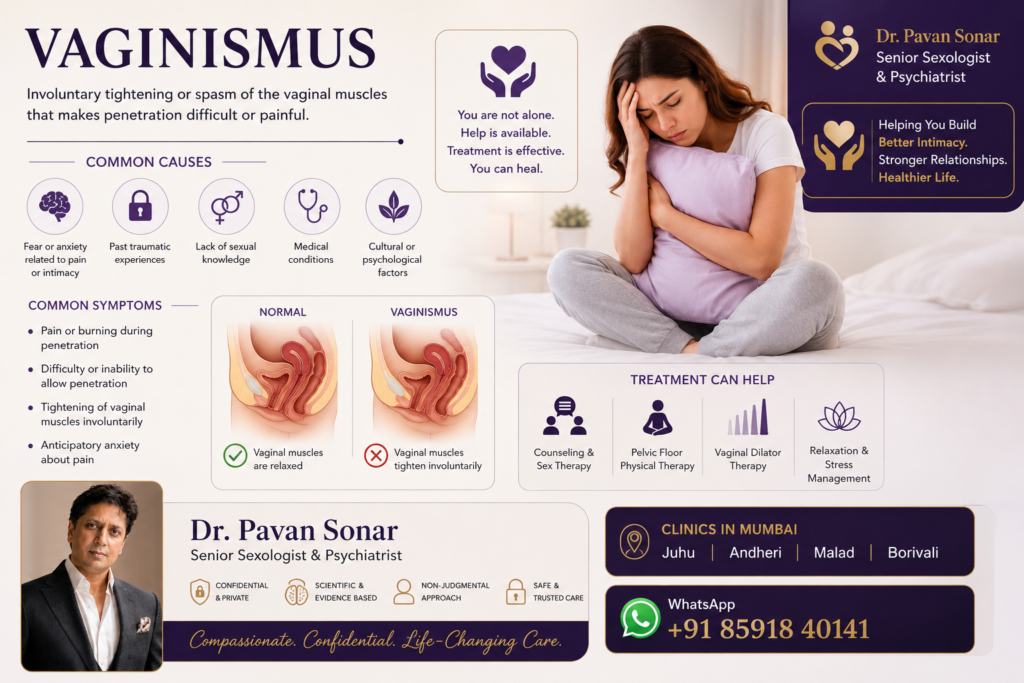
Vaginismus is the involuntary tightening or spasm of the vaginal muscles — specifically the pelvic floor — that makes vaginal penetration painful, difficult, or completely impossible. The spasm happens automatically and is not under conscious control. Women with vaginismus are not refusing penetration; their body is producing an involuntary protective response that they cannot simply “relax away.”
The condition can affect tampon use, gynaecological examinations, and sexual intercourse. Many women with vaginismus live with the condition for years — sometimes their entire marriage — without ever knowing that it has a name, a cause, and a very effective treatment.
Types of Vaginismus
Primary Vaginismus
Penetration has never been possible. This is often discovered on the wedding night or during the first gynaecological exam. The condition may have been present since adolescence but gone unidentified until penetration was first attempted. Primary vaginismus is almost always rooted in a combination of anxiety, conditioned muscular response, and — in many cases — sexual myths or cultural messages around pain and intercourse.
Secondary Vaginismus
Penetration was previously possible but has become painful or impossible following a specific event — childbirth, a gynaecological procedure, sexual trauma, menopause, repeated yeast infections, or a particularly painful sexual experience. The body has learned a new protective response to anticipated pain.
Situational Vaginismus
Penetration is possible in some situations but not others — for example, tampons may be possible but intercourse is not, or penetration is possible with one partner but not another. This pattern is almost entirely psychological in origin and responds very well to psychosexual therapy.
Causes of Vaginismus — Understanding the Root
Vaginismus is rarely caused by a single factor. In most cases, it involves a combination of psychological and physiological elements working together:
Psychological Causes
- Anxiety about pain — often the anticipation of pain is enough to trigger the spasm, even before penetration is attempted
- Sexual trauma or abuse history — including experiences the individual may not consciously identify as traumatic
- Cultural or religious messages equating sex with pain, sin, or shame
- Perfectionism and control tendencies — difficulty surrendering physical control
- Relationship anxiety — fear of vulnerability or intimacy with a specific partner
- Past negative sexual experiences — a rough first encounter can condition the body to protect itself
Physical and Medical Causes
- Vaginal infections — repeated thrush or bacterial vaginosis can cause the body to associate penetration with pain
- Hormonal changes — especially at menopause, causing vaginal dryness and atrophy
- Perineal tears or episiotomy scarring from childbirth
- Endometriosis or other gynaecological conditions causing pelvic pain
- Skin conditions affecting the vulvar area — lichen sclerosus, vulvodynia
Importantly, the psychological and physical causes reinforce each other. A physical source of pain creates psychological anticipatory anxiety. The anxiety causes muscle spasm. The spasm causes more pain. This cycle is what makes vaginismus persist long after the original physical trigger has resolved — and it is precisely this cycle that treatment must break.
Vaginismus vs. Dyspareunia — What Is the Difference?
Dyspareunia refers to genital pain during intercourse. Vaginismus refers specifically to the involuntary muscular spasm that prevents or obstructs penetration. The two conditions frequently coexist — vaginismus can cause dyspareunia, and repeated dyspareunia can trigger secondary vaginismus. Dr. Pavan Sonar treats both conditions and their overlapping presentations.
How Vaginismus Is Treated — Dr. Pavan Sonar’s Approach
Vaginismus treatment does not involve surgery, physical manipulation under sedation, or any forced procedure. The treatment is gentle, progressive, evidence-based, and designed around the individual’s pace. Treatment success rates for vaginismus are among the highest of any sexual health condition — most women achieve comfortable penetration with the right guidance.
1. Comprehensive Psychosexual Assessment
The first step is a thorough clinical consultation — exploring the history of the condition, its likely causes, relationship dynamics, cultural and family messaging around sex, and any trauma history. This assessment forms the foundation of the treatment plan. Female counsellors are available to be present during sessions at the patient’s request.
2. Psychoeducation
Most women with vaginismus have been told contradictory, confusing, or simply wrong information about their condition. Accurate education about pelvic anatomy, the nature of the muscular response, and realistic expectations for treatment is itself therapeutic. Understanding what is happening — and why — removes a significant layer of fear.
3. Cognitive Behavioural Therapy (CBT)
CBT addresses the thought patterns and beliefs that maintain the vaginismus response — anticipatory anxiety, catastrophising about pain, perfectionism around sexual performance, and shame or guilt. These are not character flaws; they are learned patterns that can be unlearned systematically.
4. Progressive Desensitisation
A graded programme of pelvic floor awareness and relaxation exercises, progressing from breathing and body awareness to progressive vaginal dilation using a sequence of dilators of increasing sizes. This is done at the patient’s own pace, privately at home, with Dr. Sonar providing guidance at each step. There is no rush. No session moves forward until the patient is comfortable.
5. Couples Sessions (Where Relevant)
Vaginismus affects both partners. Guilt, frustration, confusion, and fear are common on both sides. Structured couples sessions bring the partner into the treatment process with education about the condition, communication strategies, and sensate focus exercises designed to rebuild physical intimacy without pressure. Many couples report that working through vaginismus together significantly deepens their relationship.
6. Medical Treatment Where Appropriate
In some cases — particularly where hormonal causes are identified or where anxiety is clinically significant — medication may be recommended as part of the treatment plan. This might include topical oestrogen for vaginal atrophy, or short-term anxiolytic support for severe anticipatory anxiety. Dr. Sonar’s dual training as both a psychiatrist and a sexologist means both dimensions are managed within a single treatment plan.
Why Choose Dr. Pavan Sonar for Vaginismus Treatment in Mumbai?
- Dual qualified psychiatrist and sexologist — vaginismus has both psychological and physical dimensions; Dr. Sonar addresses both
- 22+ years of experience in sexual health and psychosexual therapy across Mumbai
- Female counsellor available on request — many patients are more comfortable with a female clinician present during sessions
- Completely confidential — no information is shared with family members or partners without explicit written consent
- Online consultations available — the assessment, psychoeducation, CBT, and couples sessions can all be conducted via secure video call for patients who prefer privacy at home
- No judgment, no rush — Dr. Sonar’s approach is grounded in patience and clinical precision, not pressure
Clinic Locations — Vaginismus Treatment in Mumbai
Dr. Pavan Sonar sees patients for vaginismus treatment at his clinics in Andheri West, Malad West, Malad East, and Borivali West. Online consultations are available for patients in Thane, Navi Mumbai, Pune, and across India. Call or WhatsApp +91 85918 40141 to book.
Frequently Asked Questions — Vaginismus Treatment in Mumbai
Is vaginismus curable?
Yes. Vaginismus is one of the most successfully treated sexual health conditions. The majority of women who complete a structured treatment programme achieve comfortable, pain-free penetration. The key is a personalised approach that addresses both the psychological and physical dimensions of the condition — not a one-size-fits-all protocol.
Can I consult for vaginismus without my husband knowing?
Yes. The initial consultations are individual — you do not need to involve your partner at the outset. Many women begin treatment individually and introduce their partner to the process later, once they feel ready. Patient confidentiality is absolute; no information is shared with family members without your written consent.
Does vaginismus treatment involve a physical examination?
A physical examination is not always required and is never forced. In cases where a physical cause is suspected — hormonal changes, infection, skin conditions — Dr. Sonar may recommend a gynaecological examination with a specialist of your choice. The psychosexual treatment itself does not require a physical examination at Dr. Sonar’s clinic.
Can vaginismus be treated online?
Yes. The core elements of vaginismus treatment — psychoeducation, CBT, desensitisation guidance, and couples sessions — can be delivered effectively via secure online video consultation. Many patients prefer the privacy of consulting from home, particularly for a condition they have not been able to discuss openly with anyone. Online consultations are available 7 days a week.
How many sessions does vaginismus treatment take?
The duration varies significantly depending on the type and severity of vaginismus, the presence of trauma, and how consistently the exercises are practised at home. Most patients see meaningful progress within 6–12 sessions. Some achieve their goals sooner; complex cases with trauma histories may take longer. Dr. Sonar sets realistic expectations at the outset and reviews progress regularly.
My husband and I have been married for years without being able to consummate. Is it too late?
It is never too late. Dr. Sonar regularly treats unconsummated marriages of many years’ duration — sometimes a decade or more. The condition does not worsen with time in a way that makes treatment less effective. What changes over time is the emotional weight both partners carry — and that, too, can be addressed in treatment. If you have been living with this silently, the most important step is simply the first consultation.
Is vaginismus common in India?
Vaginismus is more common in India than official figures suggest, largely because it goes unreported. Cultural silence around female sexuality, shame, and the absence of sexual education mean that many women suffer for years without knowing what they are experiencing has a clinical name and a treatment. Studies suggest vaginismus affects between 1% and 17% of women globally, with higher reported rates in regions with conservative cultural attitudes toward female sexuality.
Does my partner need to attend sessions?
Partner involvement is helpful but not mandatory at the outset. As treatment progresses, couples sessions become increasingly valuable for rebuilding intimacy and ensuring both partners understand the condition and the treatment process. Dr. Sonar will guide you on when and how to involve your partner based on your specific situation.
You deserve a satisfying, pain-free intimate life. Call or WhatsApp +91 85918 40141 to book a confidential vaginismus consultation in Mumbai today.