Book Appointment Now

The Doctor Who Couldn’t Ask for Help: A Hard Look at Physician Suicide

Every year, medicine quietly loses some of its own, not to outbreaks or accidents, but to suicide. These are the same people who spend their days saving lives, sitting with grieving families, and reassuring frightened patients at 3 a.m. The tragedy is that the very skills which make someone a good doctor, composure, self-sacrifice, and the instinct to put others first, are often the same traits that stop them from admitting they are drowning.
Research across countries has repeatedly shown that physicians die by suicide at higher rates than people in many other professions, and the gap is especially troubling among female doctors. These are not abstract numbers. They are classmates, mentors, the senior resident who taught you how to break bad news, the family physician who has known your parents for twenty years. Medicine trains people to recognise suffering in strangers while teaching them, almost by accident, to disregard it in themselves.
How It Happens
Physician suicide is rarely sudden. It is usually the end point of a long, quiet erosion, years of sleep deprivation, relentless call schedules, and the accumulated weight of decisions that carry life-or-death consequences. Add to this the administrative burden of modern medicine, the fear of litigation, and the emotional toll of watching patients suffer or die despite one’s best efforts, and the exhaustion becomes less like tiredness and more like a slow disappearance of the self.
There is also a darker, more clinical reality. Doctors understand pharmacology, dosage, and physiology better than almost anyone else. When a physician reaches a point of crisis, that knowledge can make an attempt far more lethal than it would be for someone without medical training. This is one reason why, even where physicians do not attempt suicide more often than the general population, they die from it more often. Knowledge meant to heal becomes, in the worst moments, a tool that ends a life with grim efficiency.
Isolation compounds all of this. Long training years, frequent transfers, and punishing schedules make it difficult to sustain friendships outside medicine. Inside the profession, hierarchy and competition can make honesty about struggling feel dangerous rather than safe.
The Stigma and Fear Behind the Silence
Ask any doctor privately, and many will admit they have thought about seeking therapy and decided against it. The reasons are rarely about not knowing where to go. They are about what asking for help might cost them.
In many countries, medical licensing applications still ask intrusive questions about past mental health treatment, effectively punishing honesty. A doctor who discloses a history of depression or a therapy visit can fear, sometimes rightly, that this admission will be used to question their fitness to practise, rather than treated as a private health matter like any other. The result is predictable: doctors learn to hide, minimise, and self-medicate rather than seek proper care.
Medical culture itself often glorifies endurance over honesty. Trainees are praised for working through illness, exhaustion, and grief, and subtly taught that needing help is a professional weakness rather than a human reality. A doctor who cries after losing a patient, or who admits to feeling hopeless, risks being seen by colleagues, and sometimes by themselves, as unfit for the very profession they trained a decade to enter. This fear does not stay contained to work. It follows doctors home, into marriages, into parenthood, into the quiet hours when no one else is watching.
The cruellest part of this stigma is that it targets exactly the people best equipped to recognise mental illness in others. Psychiatrists treat patients for depression every day and still hesitate to acknowledge their own. Surgeons who counsel families about grief often have nowhere to take their own grief. The profession that diagnoses despair in the rest of society frequently fails to see it in the mirror.
Pill-Shaming and the Stigma Around Medication and ECT
Even within medicine, there is an uncomfortable irony: many doctors who prescribe antidepressants, mood stabilisers, or recommend electroconvulsive therapy for their patients would never admit to needing these treatments themselves. Pill-shaming often starts inside the profession, not outside it, with senior doctors sometimes dismissing psychiatric medication as a crutch, or joking about colleagues who take antidepressants as being too sensitive for the job.
Electroconvulsive therapy, or ECT, remains one of the most effective and fastest-acting treatments available for severe depression and acute suicidal crisis, yet it is still associated in the public imagination, and sometimes even among clinicians, with outdated portrayals from decades-old films. Its actual modern practice is done under anaesthesia, closely monitored, and backed by a strong safety record. This gap between perception and reality is not harmless. Patients who might genuinely benefit from ECT are sometimes talked out of it, by family, by their own fear, or occasionally by a doctor uncomfortable recommending it, even when it could be the treatment that saves their life.
Antidepressants and other psychiatric medications are frequently mischaracterised as mind-altering or addictive, when for many patients in suicidal crisis they are what makes daily survival possible. When doctors themselves hesitate to trust these treatments for their own colleagues, or quietly avoid taking them despite needing them, it reinforces an unspoken message to patients that psychiatric treatment is somehow less legitimate than treatment for a physical illness. A profession that half-believes its own medicine cannot fully convince anyone else to believe in it.
False Assumptions That Keep the Problem Invisible
There are widely held misconceptions that make this crisis harder to see, let alone address. One is the assumption that a successful, well-paid, respected physician has no reason to be suicidal, as though achievement and internal suffering cannot coexist in the same person. Another is the belief that asking someone directly whether they are having thoughts of suicide will plant the idea in their mind. The evidence says the opposite: asking directly, calmly, and without judgment is one of the most protective things another person can do.
A third assumption is that medical training itself equips someone to manage their own mental health without outside help. It does not. Years of training in recognising illness in others can make a person worse, not better, at recognising it in themselves, and more skilled at explaining away their own symptoms with a differential diagnosis that always somehow excludes them.
When the Media Gets Suicide Reporting Wrong
News coverage plays an outsized role in this story. Sensational headlines that describe the exact method or location of a suicide, front-page placement of a death, and dramatic phrasing that turns someone’s final act into a tragic end to a battle can function less like reporting and more like a script. This is not speculation; researchers have documented a real rise in similar deaths following certain kinds of coverage, sometimes called suicide contagion. When a well-known doctor dies by suicide, some publications rush to detail exactly how it happened, information that serves no public interest and carries a genuine risk of copycat behaviour among vulnerable readers.
Responsible reporting guidelines exist for exactly this reason: avoid describing the method or location in detail, avoid front-page or sensational placement, include a helpline number wherever the story is published, and frame the coverage around context and prevention rather than spectacle. When editors ignore these guidelines, they are not merely getting a detail wrong. They may be contributing, quietly and measurably, to the very tragedy they are reporting on.
What Prevention Actually Requires
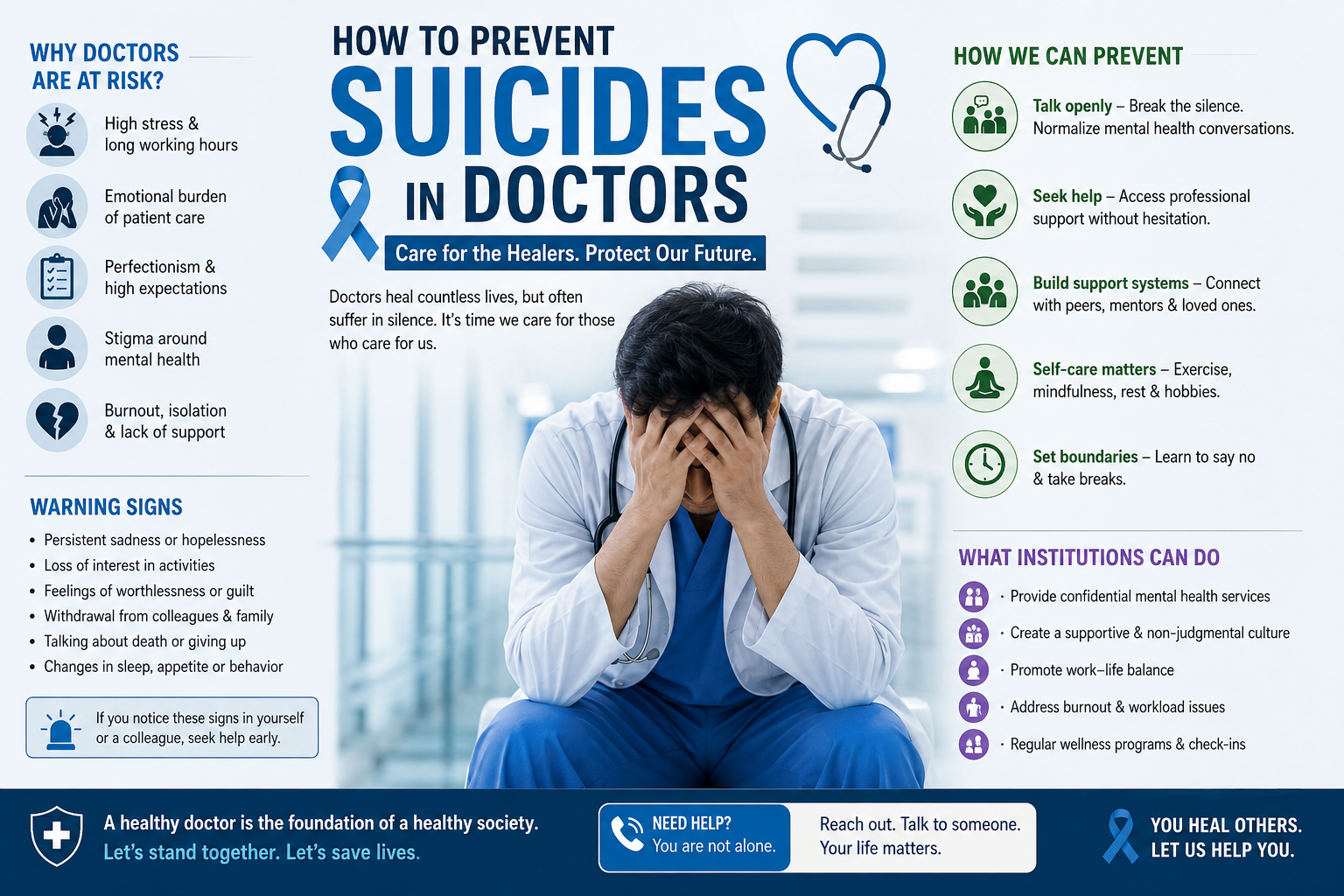
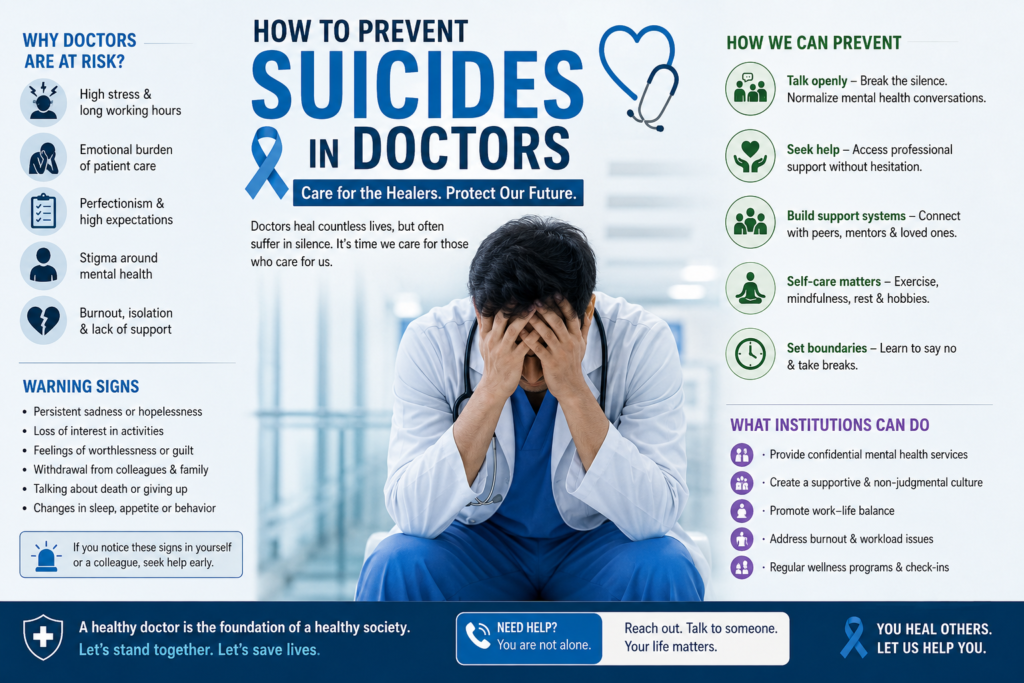
Awareness posters and wellness webinars, however well-intentioned, rarely change outcomes on their own. Meaningful prevention requires structural change, not just encouragement to reach out.
Hospitals and medical boards need confidential mental health support that is genuinely separate from licensing and disciplinary processes, so that seeking help is never confused with risking one’s career. Institutions must reduce excessive work hours, unsustainable patient loads, and the administrative burden that eats into time meant for rest and recovery. Peer support programmes, where trained colleagues check in informally and without judgment, have shown real promise in normalising conversations about struggling. Medical education itself needs to change from the first year of training, teaching students that seeking therapy is a sign of professional maturity, not failure.
On a more personal level, colleagues, friends, and family members can make a real difference simply by paying attention. A doctor who has become withdrawn, cynical, uncharacteristically irritable, or who jokes darkly about not caring anymore is not being dramatic, they may be sending the only signal they feel safe sending. Asking directly, listening without trying to fix everything immediately, and gently helping someone access professional support can genuinely save a life.
We ask doctors to be endlessly available for us, at 2 a.m., on their birthdays, through their own grief and illness. We rarely ask, with any real sincerity, whether they themselves are okay, and even more rarely do we build a system where they could safely say no. Until medicine becomes a profession where a doctor can admit to struggling without fearing for their career, we will keep losing the people we depend on most, quietly, and largely unnoticed by the rest of us.
Free and Confidential Helpline Numbers
If you are a doctor, or anyone else, going through a difficult time, please reach out. You do not have to carry this alone.
- iCall (TISS), India: 9152987821
- Vandrevala Foundation, India: 1860-2662-345 / 1800-2333-330
- AASRA, India: 91-22-27546669
- Sneha Foundation, Chennai: 044-24640050
- NIMHANS Toll-Free, India: 080-46110007
- 988 Suicide and Crisis Lifeline, USA and Canada: 988
- Samaritans, UK and Ireland: 116 123
- For a global directory of crisis lines, visit befrienders.org
Helpline numbers can change over time, please verify the current number before sharing widely. If someone is in immediate danger, contact local emergency services right away.