Book Appointment Now

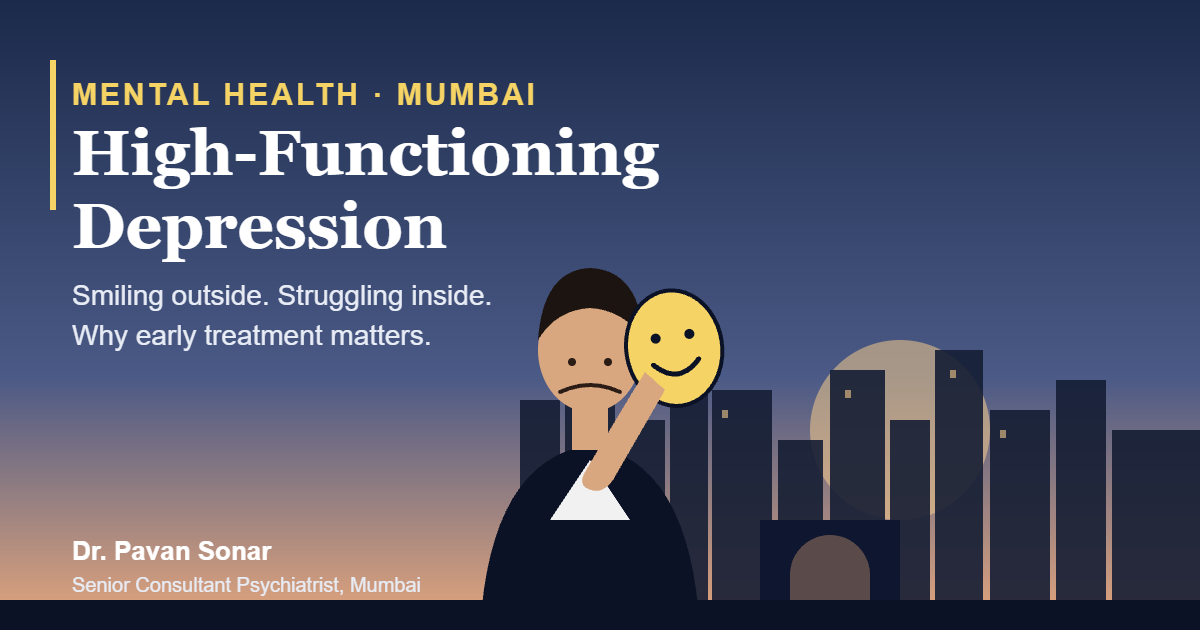
High-Functioning Depression in Mumbai: Signs, Causes & Why Treatment Matters
Smiling, successful and secretly struggling? Learn the signs of high-functioning depression, why it goes unnoticed in Mumbai, and why early treatment with a psychiatrist matters.

By Dr. Pavan Sonar, Senior Consultant Psychiatrist & Sexologist, Mumbai (MBBS, DPM, DNB Psychiatry, MS Counselling & Psychotherapy)
You wake up before the alarm, catch the 8:12 from Borivali, deliver the presentation, answer every email, attend the family function and post the cheerful photo. By every outside measure, you are doing well. And yet, somewhere underneath, there is a heaviness you cannot name: a constant tiredness, a flat joyless feeling, a quiet voice that says nothing you do is ever enough.
If this sounds familiar, you may be living with high-functioning depression. In my 22+ years of clinical practice as a psychiatrist in Mumbai, this is one of the most common, and most overlooked, presentations I see. People walk into my clinic saying, “Doctor, I don’t think I’m really depressed. I’m working, I’m managing everything. But I feel dead inside.”
In this detailed guide, I explain what high-functioning depression is, how it shows up in the lives of Mumbaikars, what causes it, why leaving it untreated is risky, and what effective treatment looks like.
Table of Contents
- What Is High-Functioning Depression?
- Is It an Official Diagnosis?
- Common Signs and Symptoms
- Why It Is So Common (and So Hidden) in Mumbai
- Causes and Risk Factors
- Myths That Delay Treatment
- Why Treatment Is Important
- How High-Functioning Depression Is Treated
- Self-Help Strategies That Support Treatment
- When to See a Psychiatrist
- Frequently Asked Questions
What Is High-Functioning Depression?
High-functioning depression is a popular term for a form of depression in which a person continues to meet daily responsibilities (going to work, running a home, studying, socialising) while quietly suffering from persistent low mood, exhaustion, self-doubt and emotional numbness.
The key word is persistent. Unlike a severe depressive episode that may leave someone unable to get out of bed, high-functioning depression is often long-lasting, lower in intensity, and well-hidden. The person pushes through, so family, friends and even colleagues rarely notice. Often, the person themselves does not realise it is depression. They assume that this is simply “how life is” or “my personality.”
Is High-Functioning Depression an Official Diagnosis?
“High-functioning depression” is not a formal diagnostic label in the DSM-5 or ICD-11. It is a descriptive, everyday term. Clinically, what people call high-functioning depression most often corresponds to Persistent Depressive Disorder (PDD), formerly called dysthymia, in which a depressed mood lasts most of the day, on most days, for at least two years in adults, along with other symptoms such as poor appetite or overeating, sleep problems, low energy, low self-esteem, poor concentration and hopelessness.
It can also be an ongoing Major Depressive Disorder that is simply being masked by determination and routine. Only a careful evaluation by a qualified psychiatrist can tell which one applies to you. This is why self-diagnosis from social media is never enough, and why a proper assessment matters.
Common Signs and Symptoms of High-Functioning Depression
Because the person appears successful, the signs are subtle. Watch for the following patterns, especially if they have lasted for weeks, months or years:
Emotional signs
- A persistent low, empty or flat mood that never fully lifts, even on good days.
- Loss of joy (anhedonia): achievements, holidays and hobbies bring little satisfaction.
- Harsh self-criticism and a feeling of being a fraud or “not good enough,” whatever you accomplish.
- Irritability and a short temper, particularly with the people closest to you.
- Hopelessness about the future, even while you plan for it.
Physical signs
- Constant fatigue that sleep does not fix.
- Changes in sleep: insomnia, waking at 3 or 4 a.m., or sleeping too much on weekends.
- Appetite and weight changes, including emotional eating.
- Unexplained aches, headaches, acidity or body pain with no clear medical cause.
Behavioural and thinking signs
- Perfectionism and overworking as a way to outrun difficult feelings.
- Difficulty concentrating or making even small decisions.
- Social withdrawal in disguise: you attend events but feel disconnected, then cancel plans quietly.
- Procrastination and a sense of “running on empty” despite looking productive.
- Relying on alcohol, smoking, late-night scrolling or excessive caffeine to cope.
- Reduced sexual desire or intimacy problems, an often-ignored sign that I see regularly in clinic.
A useful self-check: “If I stopped performing, would I fall apart?” If your functioning depends entirely on exhaustion-driven effort, and you feel little reward for it, it is worth speaking to a professional.
Why High-Functioning Depression Is So Common (and So Hidden) in Mumbai
Mumbai is a city that rewards endurance. “The spirit of Mumbai” is celebrated, but that same spirit can make it very hard to admit that you are not coping. Several features of city life make high-functioning depression especially likely to go unnoticed:
1. The commute and the clock. Hours lost in local trains, traffic and long distances between Andheri, Malad, Borivali and South Mumbai eat into sleep, family time and rest. Chronic fatigue is normalised, so depression-related exhaustion is easily dismissed as “just Mumbai tiredness.”
2. Hustle culture and high expectations. Competitive jobs, startup pressure, corporate targets, entrance exams, high rents and the cost of living create a constant sense that you must keep performing. Many professionals tie their self-worth to output.
3. Stigma and “log kya kahenge.” Worry about what family, community and colleagues will think stops many from seeking help. A visit to a psychiatrist is still seen by some as a sign of weakness or “madness,” when it is simply medical care for the brain and mind.
4. Loneliness in a crowded city. It is possible to be surrounded by millions and still feel deeply alone, especially for migrants, students, young professionals living away from home, and elderly parents whose children have moved abroad.
5. Being the “strong one.” Many Indians, especially working women juggling home and career, and men taught that “boys don’t cry,” are expected to hold everyone else together. Their own distress goes unspoken.
National surveys, including the National Mental Health Survey of India, have repeatedly shown that a large proportion of people with common mental disorders, including depression, never receive treatment. The gap between those who need help and those who get it remains wide. High-functioning depression sits right in the middle of this gap, because the person looks well enough that nobody, including the person, insists on help.
Causes and Risk Factors
Depression is never caused by “weakness” or lack of willpower. It develops from a combination of biological, psychological and social factors:
- Biological factors: differences in brain chemistry and stress-response systems, hormonal changes (thyroid problems, postpartum and perimenopausal changes), and chronic illness.
- Genetics: a family history of depression or anxiety increases risk.
- Early life experiences: a critical or emotionally unavailable upbringing, early loss, or constant pressure to achieve can leave a lifelong tendency toward self-criticism.
- Personality traits: perfectionism, people-pleasing and an excessive sense of responsibility.
- Chronic stress: long work hours, financial strain, caregiving burden, relationship conflict.
- Lifestyle factors: poor sleep, little physical activity, alcohol or substance use, and screen overuse.
Myths That Delay Treatment
Myth: “If I can work and smile, I can’t be depressed.”
Fact: Depression is defined by what you feel and how long you feel it, not by whether you can still perform. Many people with depression continue to function, at a heavy personal cost.
Myth: “It’s just stress. It will pass.”
Fact: Stress usually eases when the pressure eases. Depression continues even when circumstances improve.
Myth: “Depression needs a reason.”
Fact: Depression can appear even when life looks perfect on paper. Having a good job, family and home does not protect against it.
Myth: “Antidepressants are addictive and change your personality.”
Fact: Modern antidepressants, when prescribed and monitored by a psychiatrist, are not addictive in the way many fear, and they do not change who you are. They help restore the ability to feel normal emotions again.
Myth: “Just think positive and exercise.”
Fact: Lifestyle changes help, but clinical depression is a medical condition that often needs professional treatment.
Why Treating High-Functioning Depression Is So Important
Because the person is “coping,” it is tempting to postpone treatment. This is the most dangerous mistake. Here is why timely treatment matters:
1. It rarely stays “mild”
Long-standing, untreated depression can deepen over time. A person who is high-functioning today may, after a major stressor such as a job loss, bereavement, breakup or illness, slide into a severe episode. Persistent depression is also associated with a higher chance of developing major depressive episodes on top of it, often called “double depression.”
2. Risk of suicidal thoughts is real
People with high-functioning depression are sometimes the ones whose distress shocks everyone when it surfaces, because they hid it so well. Hopelessness and thoughts of not wanting to live are never to be ignored, whatever your outward success. If you are having such thoughts, please reach out for help immediately (see the helplines at the end of this article).
3. It affects your body
Chronic depression is linked with sleep disorders, heart disease risk, blood pressure and diabetes problems, weakened immunity, chronic pain and digestive complaints. Treating the mind is part of protecting the body.
4. It damages relationships
Emotional withdrawal, irritability and loss of interest slowly erode marriages, parenting, friendships and intimacy. Partners often feel shut out without understanding why. Many couples I see have a depression issue at the root of what looks like a “relationship problem.”
5. It silently harms your career
Even if you are performing, depression reduces creativity, motivation, memory and enjoyment. Burnout, mistakes and sudden resignations are common endpoints. Treatment often restores the energy and clarity that people did not realise they had lost.
6. It increases the risk of substance use
Many high-functioning individuals self-medicate with alcohol, nicotine or sleeping pills. Treating the underlying depression reduces the need for these unhealthy coping methods.
7. It affects sexual health
Low desire, erectile difficulties, delayed or reduced arousal and intimacy avoidance are common, and often under-reported, consequences of depression. As a psychiatrist who is also a sexologist, I see how closely mental and sexual wellbeing are connected. Addressing both together leads to better outcomes.
8. Early treatment works better
Depression responds well to treatment, and the earlier it is addressed, the faster and more completely most people improve. You do not have to wait until you “hit rock bottom.”
How High-Functioning Depression Is Treated
The good news: this is a highly treatable condition. Treatment is individualised after a detailed clinical evaluation, and usually combines the following.
1. Comprehensive psychiatric assessment
The first step is a confidential, unhurried consultation. I explore your symptoms, history, sleep, stress, family background, medical conditions, substance use and sexual health. Where relevant, basic investigations (such as thyroid function, vitamin D and B12 levels, or blood counts) are advised to rule out physical causes that mimic depression.
2. Psychotherapy and counselling
Cognitive Behavioural Therapy (CBT) is among the most extensively researched treatments for depression. It helps you identify harsh thought patterns (“I’m a failure”), test them against reality, and build healthier behaviours. Other approaches, such as interpersonal therapy, supportive counselling and mindfulness-based techniques, may be used according to your needs. With my additional training in counselling and psychotherapy, therapy and medical management can be coordinated under one roof.
3. Medication when appropriate
For moderate to long-standing depression, antidepressant medicines can make a significant difference, especially when symptoms have lasted for years. Medication is chosen carefully based on your symptoms, other health conditions and preferences, and is monitored regularly. It is never to be started, stopped or adjusted on your own. Many patients describe the effect as “the fog lifting.”
4. Lifestyle medicine
Structured changes in sleep, physical activity, nutrition, sunlight exposure, alcohol use and screen time support recovery and reduce relapse.
5. Work-life and life-coaching support
Many professionals benefit from guidance on boundaries, perfectionism, goal-setting and rebuilding purpose. Coaching is a helpful complement once the clinical aspects are being addressed, but it is not a substitute for medical treatment where depression is present.
6. Family and couple involvement
Where appropriate, involving a partner or family member improves understanding, reduces stigma at home and strengthens recovery.
7. Follow-up and relapse prevention
Recovery is a process. Regular follow-ups, early recognition of warning signs and a clear maintenance plan help you stay well in the long term.
Self-Help Strategies That Support Treatment
These habits do not replace professional care but strengthen it:
- Protect your sleep. Keep fixed sleep and wake times, avoid screens in the last hour before bed, and limit late-night caffeine.
- Move daily. Even a 20 to 30 minute brisk walk along Marine Drive, Carter Road, Powai Lake or a nearby garden improves mood.
- Get morning light. Natural sunlight helps regulate your body clock.
- Schedule small pleasures. Plan one thing every day that you used to enjoy, even if you do not feel like it yet.
- Break tasks down. Depression makes big tasks feel impossible. Smaller steps rebuild momentum.
- Limit alcohol. It worsens mood and sleep over time.
- Speak to one trusted person. Saying it out loud reduces its power.
- Be kind to yourself. Notice the inner critic, and ask: “Would I speak this way to a friend?”
When Should You See a Psychiatrist?
Consider booking a consultation if:
- Low mood, emptiness or exhaustion has lasted for two weeks or longer, or has been present on and off for years.
- You are functioning, but only by forcing yourself, and you feel no joy.
- Sleep, appetite, concentration or sexual interest has changed noticeably.
- You are relying on alcohol or other substances to cope.
- People close to you have said you seem distant, irritable or “not yourself.”
- You have thoughts that life is not worth living. In this case, please seek help right away.
Consult a Psychiatrist for Depression Treatment in Mumbai
You do not have to carry this alone, and you do not have to wait until things fall apart. Dr. Pavan Sonar is a Senior Consultant Psychiatrist with over 22 years of clinical experience, a member of the Indian Psychiatric Society and the Bombay Psychiatric Society, and a recipient of Outlook India Best Doctor recognition (Best Psychiatrist Mumbai, 2024 and 2026). Consultations are confidential, respectful and free of judgement.
Clinic locations across Mumbai:
- Andheri West: Bellevue Hospital
- Malad West: Riddhivinayak Hospital
- Malad East: Bhavani Chambers / New Sanjeevani Hospital
- Borivali East: Galaxy Multi Speciality Hospital
Premium home visits are also available across Mumbai for patients who prefer care in the comfort and privacy of their own home.
Book your confidential consultation today. Taking the first step is often the hardest, and the most important.
Frequently Asked Questions (FAQs)
What is high-functioning depression?
It is a non-clinical term for depression in which a person continues to work and manage daily life while suffering from persistent low mood, fatigue, self-doubt and loss of joy. It often corresponds to Persistent Depressive Disorder or to a masked major depression.
Is high-functioning depression serious?
Yes. Even though the person appears to cope, it can worsen over time, affect physical health, relationships and work, and increase the risk of severe depression and suicidal thoughts if left untreated.
How is high-functioning depression different from normal sadness or stress?
Sadness and stress are linked to specific events and ease with time or relief. Depression is persistent, often affects sleep, energy, appetite and enjoyment, and continues even when life circumstances appear fine.
Can high-functioning depression go away without treatment?
Sometimes symptoms fluctuate, but persistent depression rarely resolves fully on its own. Without treatment it tends to continue for years. Professional treatment gives the best chance of full recovery.
How is high-functioning depression diagnosed?
Through a detailed clinical interview by a qualified psychiatrist, sometimes supported by standard questionnaires and blood tests to rule out physical causes such as thyroid problems or vitamin deficiencies.
Will I need medication?
Not everyone does. Treatment depends on the severity and duration of your symptoms. Some people improve with therapy and lifestyle changes alone, while others benefit from medication, often combined with therapy. Your psychiatrist will explain the options and decide with you.
How long does treatment take?
Many people begin to notice improvement within a few weeks, though full recovery commonly takes several months. Because persistent depression is long-standing, a longer and steadier course of treatment and follow-up is often advised to prevent relapse.
Is consulting a psychiatrist in Mumbai confidential?
Yes. Medical confidentiality is a core professional and ethical duty. Your consultation and records are private.
Can high-functioning depression affect sexual health?
Yes. Reduced desire, erectile difficulty and intimacy problems are common in depression, and some medicines can also affect sexual function. A psychiatrist who is also trained in sexual medicine can address both together.
Do you offer online or home consultations?
Home visits are available across Mumbai. Please contact the clinic to discuss consultation options and availability.
If You Are in Crisis
If you or someone you know is thinking about suicide or self-harm, please do not wait. Contact local emergency services, go to the nearest hospital emergency department, or call Tele-MANAS, India’s government mental health helpline, at 14416 or 1-800-891-4416 (free, 24/7). Please also tell a trusted family member or friend so you are not alone.
Disclaimer: This article is for general education and awareness only. It is not a substitute for personal medical advice, diagnosis or treatment. Please consult a qualified mental health professional about your individual situation.